Office Address
4th Floor, College House
University Way, Nairobi, Kenya
Phone Number
+254 721 827 030
0700 348 238
Email Address
info@ackers.co.ke
4th Floor, College House
University Way, Nairobi, Kenya
+254 721 827 030
0700 348 238
info@ackers.co.ke







 by Joan Blessing
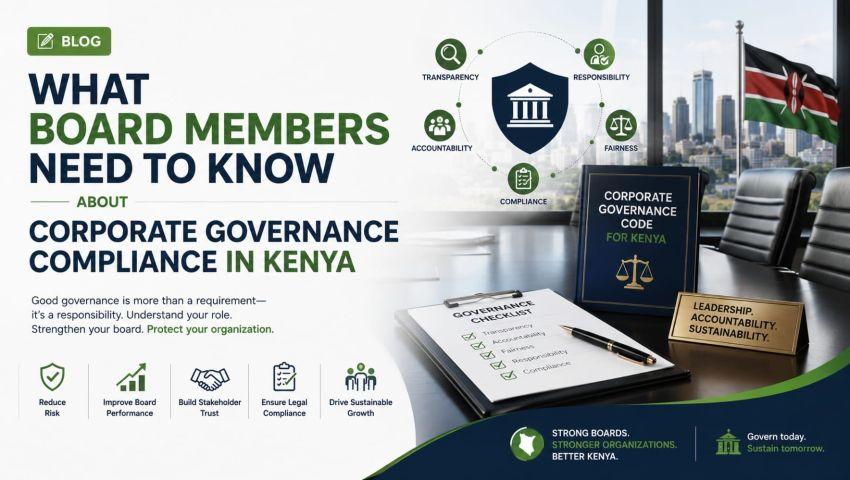
Serving on a board is an honor — and a responsibility that carries real legal and financial weight. Whether you sit on the board of a SACCO, a private company, or a state-affiliated institution, governance compliance isn't background paperwork. It's one of the most direct levers you have for protecting the organization, and yourself, from risk.
Governance is risk management, not bureaucracy
It's easy to think of governance compliance as a box-ticking exercise — signing off on policies, attending quarterly meetings, reviewing reports prepared by management. But weak governance is consistently at the root of the failures that make headlines: financial mismanagement, fraud, regulatory penalties, and reputational collapse. Strong governance practices exist precisely to catch problems before they become crises.
What every board member should be actively reviewing
The most common governance gap we see
In our governance training and advisory work, the most frequent gap isn't a lack of policy documents — most organizations have governance policies on file. The gap is between what's written and what's practiced. Boards that don't regularly stress-test their own governance structures — asking "would this actually hold up under audit or investigation?" — are the ones most exposed when something goes wrong.
Succession planning is a governance issue too
Good governance also means planning for leadership continuity. Boards that wait until a CEO or senior leader departs to think about succession are taking on unnecessary risk. Leadership development and succession planning should be a standing governance agenda item, not a reactive scramble.
Corporate governance compliance protects the organization — but it also protects you personally as a board member, by demonstrating you exercised due diligence and oversight. At Ackers Institute of Management, our Leadership & Governance training helps boards move from paper compliance to practiced compliance, covering corporate governance oversight, ethics monitoring, stakeholder engagement, and leadership succession planning.