
Office Address
4th Floor, College House
University Way, Nairobi, Kenya
Phone Number
+254 721 827 030
0700 348 238
Email Address
info@ackers.co.ke
4th Floor, College House
University Way, Nairobi, Kenya
+254 721 827 030
0700 348 238
info@ackers.co.ke











 by Joan Blessing
Many Kenyan SMEs run their sales efforts informally — a founder's personal network, referrals, and ad-hoc follow-ups. That approach can work in the early days, but it caps growth: revenue becomes unpredictable, opportunities fall through the cracks, and the business can't scale beyond the founder's personal capacity to sell. Building a structured sales pipeline fixes this — and it's more achievable than most SME owners assume.
Start with real market research, not assumptions
Before building a pipeline, get clear on who you're actually selling to. Market research and analysis — studying customer needs, competitors, and market trends — should inform your sales strategy from the start, rather than being skipped in favor of jumping straight into outreach. SMEs that skip this step often waste effort chasing leads that were never a strong fit.
Build visibility before you need it
Branding and promotion — building brand awareness through advertising, PR, digital campaigns, and creative communication — should run continuously, not just when sales are slow. Prospects who've encountered your brand before you reach out convert at a meaningfully higher rate than cold outreach.
Structure your lead generation, don't leave it to chance
Lead generation and business development — identifying prospects, nurturing leads, and expanding the customer base — works best as a deliberate, ongoing process rather than a reactive scramble whenever revenue dips. This means defining where your leads will come from (referrals, digital channels, networking, partnerships) and building a consistent cadence for pursuing them.
Design an actual sales strategy — with targets and a real pipeline
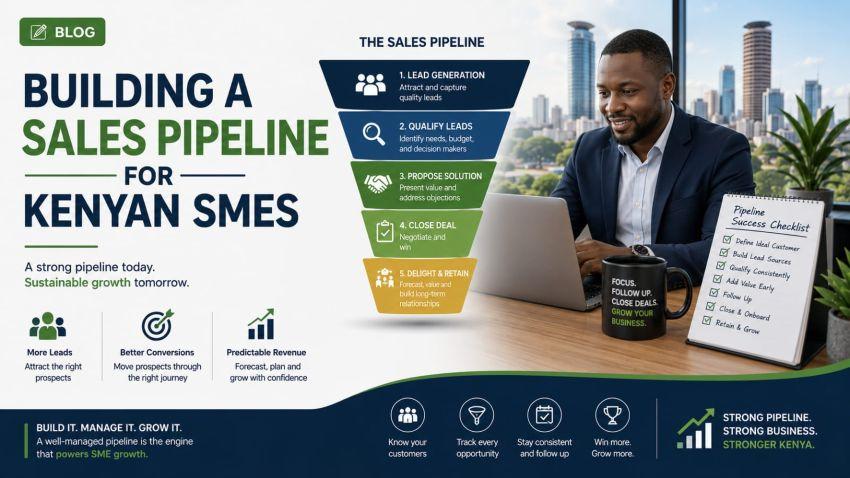
Sales strategy and execution — designing sales plans, setting targets, managing pipelines, and closing deals — is where many SMEs have the biggest gap. A pipeline doesn't need complex software to start; it needs clearly defined stages (prospect → qualified lead → proposal → negotiation → closed) and a habit of tracking where every prospect sits in that process.
Protect the relationship after the sale
Customer Relationship Management — maintaining strong client relationships, handling inquiries, and ensuring repeat business — is often the most overlooked stage. Many SMEs invest heavily in winning a new client, then under-invest in retaining them. Repeat business and referrals from existing clients are typically far cheaper to generate than new leads, making relationship management one of the highest-return activities in the entire pipeline.
Track performance so you can actually improve
Performance tracking and reporting — measuring ROI, analyzing campaign effectiveness, and refining strategies for growth — turns sales from guesswork into a system you can improve deliberately. Without this step, SMEs tend to repeat whatever worked last time, even after market conditions change.
A structured sales pipeline — grounded in real market research, consistent lead generation, disciplined pipeline management, and genuine customer relationship follow-through — is what allows an SME to grow revenue predictably instead of chasing it reactively. At Ackers Institute of Management, our Sales & Marketing training helps SME owners and sales teams build exactly this kind of structured, sustainable pipeline.