
Office Address
4th Floor, College House
University Way, Nairobi, Kenya
Phone Number
+254 721 827 030
0700 348 238
Email Address
info@ackers.co.ke
4th Floor, College House
University Way, Nairobi, Kenya
+254 721 827 030
0700 348 238
info@ackers.co.ke







 by Joan Blessing
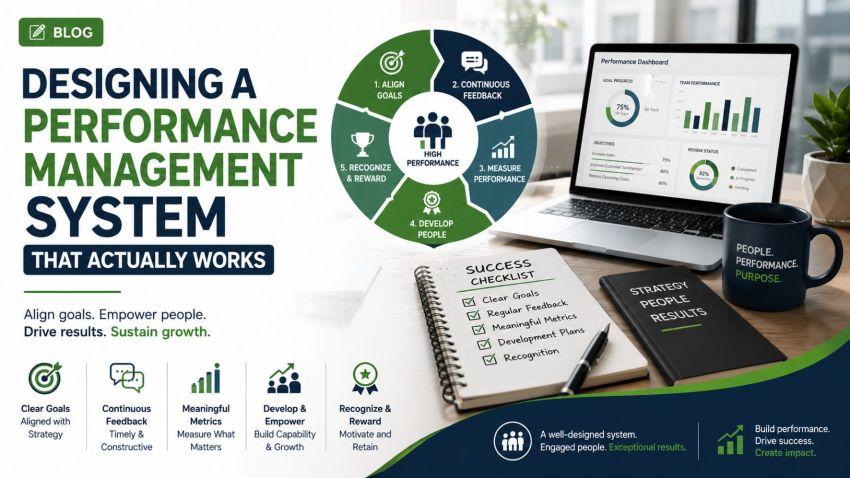
Ask almost any HR professional in Kenya about their organization's performance management system, and you'll likely hear a version of the same complaint: it exists, everyone fills in the forms once a year, and almost nobody believes it actually drives better performance. That disconnect isn't inevitable — it's usually a design problem, and it's fixable.
Why most systems fail
The most common failure pattern looks like this: KPIs are set once a year, disconnected from day-to-day work; managers treat the annual review as a compliance exercise rather than a real conversation; and the system generates a rating, but no meaningful feedback loop for improvement. The result is a system that consumes real staff time but produces very little actual performance change.
What a working performance management system actually requires
1. KPIs that connect to company goals, not just job descriptions Setting KPIs is a starting point, not the finish line. The KPIs your teams work toward should visibly connect to organizational objectives — so employees understand why their targets matter, not just what they are.
2. Evaluation that happens more than once a year Annual reviews alone almost always fail, because they try to compress twelve months of performance into a single conversation, usually recalling only the last few months clearly. Quarterly or even monthly check-ins keep performance conversations current and actionable.
3. Alignment between individual performance and company goals Employee performance evaluation should be explicitly tied to company-wide goals — not run as a parallel, disconnected HR process. When staff can see the line between their target and the organization's direction, performance conversations become more motivating and less bureaucratic.
4. Real learning and development pathways, not just ratings A performance system that only produces a score, with no linked development plan, misses half the point. Learning and development — training programs, career development plans, and leadership coaching — should flow directly out of performance reviews, so gaps identified in evaluation are actually addressed.
5. A genuine employee relations and engagement layer Performance management doesn't happen in a vacuum. A workplace culture with poor employee relations, unresolved conflict, or low engagement will undermine even a well-designed system. Fostering a positive workplace culture and proactively resolving conflict are part of what makes performance conversations productive rather than defensive.
6. Organizational design that supports the system, not fights it Sometimes the barrier to good performance management isn't the system itself — it's an organizational structure with unclear roles, overlapping responsibilities, or reporting lines that make accountability murky. Structuring teams and defining roles clearly is foundational groundwork that performance management depends on.
A performance management system succeeds or fails based on design, not intention. At Ackers Institute of Management, our Human Resource & Organizational Development training helps HR teams and people managers build systems that connect KPIs to strategy, keep evaluation ongoing rather than annual, and link every review to a real development pathway — so performance management becomes a tool people actually use.