
Office Address
4th Floor, College House
University Way, Nairobi, Kenya
Phone Number
+254 721 827 030
0700 348 238
Email Address
info@ackers.co.ke
4th Floor, College House
University Way, Nairobi, Kenya
+254 721 827 030
0700 348 238
info@ackers.co.ke











 by Joan Blessing
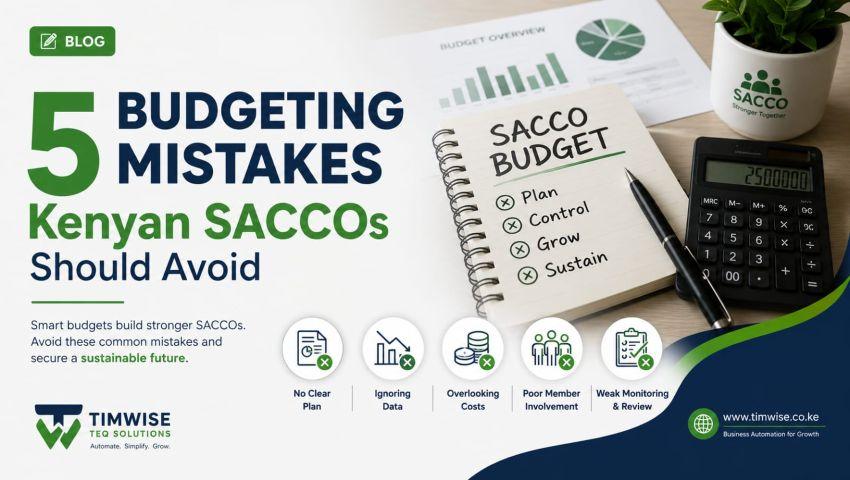
SACCOs occupy a unique position in Kenya's financial landscape. Unlike commercial banks, they answer directly to their members — which means a budgeting mistake doesn't just show up on a balance sheet, it shows up in member trust. After years of training finance teams and boards across the cooperative sector, we've noticed the same five budgeting mistakes surfacing again and again. Here's what to watch for.
1. Building the budget around last year's numbers, not this year's reality
It's tempting to roll forward last year's budget with a small adjustment for inflation. But member deposit patterns, loan demand, and operating costs shift year to year — especially with interest rate changes and evolving member expectations. A budget built purely on historical numbers will consistently under- or over-estimate revenue, leaving departments either starved of resources or padded with slack nobody notices until year-end.
Fix: Build your budget from a fresh revenue and expense forecast each cycle, using current membership trends and loan book performance — then compare it against last year as a sense-check, not a starting point.
2. Treating expense monitoring as a year-end activity
Many SACCOs review actual-versus-budget spending only at mid-year or year-end reviews. By then, overspending in one department has often already compounded into a real financial problem.
Fix: Monthly expense tracking against budget, with a simple variance report to management, catches cost overruns while they're still small enough to correct.
3. Underestimating debt and credit exposure
Loan books are a SACCO's core asset — and its core risk. Budgets sometimes assume historical repayment rates will hold indefinitely, without stress-testing for economic downturns or sector-specific shocks (agriculture-based SACCOs, for example, are exposed to weather and commodity price swings).
Fix: Build provisioning for non-performing loans into your annual budget based on a realistic, not optimistic, repayment scenario.
4. Leaving investment and wealth-growth planning out of the budget entirely
Budgeting is often treated purely as a cost-control exercise, when it should also answer: where should surplus funds be invested to grow member value responsibly? SACCOs that don't budget explicitly for investment strategy tend to leave surplus cash idle or under-optimized.
Fix: Include an investment and wealth-growth line in your annual financial plan, reviewed against your risk appetite and member interests.
5. Skipping financial capacity building for staff and board members
A technically sound budget still fails if the people executing it — branch managers, department heads, board members — don't fully understand how to read and act on it. We've seen well-designed budgets undermined simply because non-finance staff didn't know how to interpret a variance report.
Fix: Invest in financial literacy training for staff and board members alongside the budgeting process itself, not as an afterthought.
Budgeting mistakes rarely come from a lack of effort — they come from process gaps that are easy to miss when you're close to the numbers every day. At Ackers Institute of Management, our Financial Literacy & Management training equips SACCO boards, finance teams, and branch managers with the tools to budget, forecast, and monitor spending with confidence — grounded in the realities of Kenya's cooperative sector.
Want to strengthen your SACCO's financial planning process? Explore our Financial Literacy & Management training or talk to our team about a tailored session for your board and finance staff.